Thứ Năm, 25 tháng 12, 2014

Vietnamese wedding ceremony

Depending on habits of specific ethnic groups, marriage includes various steps and related procedures, but in general, there are two main ceremonies:

Le an hoi (betrothal ceremony):

Normally, both bride and groom or their parents go to the fortuneteller to see what date and time is best for them. They strongly believe in this date and time so the groom's family and relatives must come on time. Some days before the wedding, they will visit the bride and her family with round lacquered boxes known as betrothal presents. It composes of areca nuts and betel leaves, tea, cake, fruits, wines and other delicacies which covered with red cloth and carried by unmarried girls or boys. Don ca tai tu – The soulful voice floating along rivers

Le cuoi (wedding ceremony):
On the wedding day, the groom's family and relatives go to the bride's house bringing a lot of gifts wrapped in red papers. These gifts are similar to those of the engagement: betel leaves and areca nuts, wines, fruits, cakes, tea ... The persons hold these trays are also carefully chosen, usually they are happily married couples. Ladies and women are all dressed in Ago Dai. Men could be in their suits or men traditional Ao Dai. The troop is usually led by a couple that is most wealthy and successful among the relatives, this means to wish the to-be-wed couples a blessing life together in the future. Full-Day Mekong Delta Tour, Vietnam


The groom's family would stop in front of the bride's house. The leading couple should enter the house first with a tray with wine. They would invite the bride's parents to take a sip. By accepting the toast, the bride's family agrees for the groom’s family to enter their house. The firework is immediately fired to greet the groom's family.

Sapa tours and premier destinations

Vietnamese wedding ceremony

The groom's family would introduce themselves and ask permission for their son to marry his bride. The master of the ceremony (usually a respected person among the bride's relatives) instructs the bride's parents to present their daughter. The bride then follows her parents out. She will wear red traditional wedding ao dai, followed by her bride maids. The couple should pray before the altar ask their ancestors for permission for their marriage, then express their gratitude to both groom’s and bride’s parents for raising and protecting them.

Then, they bow their head to each other to show their gratitude and respect toward their soon-to-be husband or wife. The master of the ceremony would gave the wedding couple advices on starting a new family. Their parents would take turn to share their experience and give blessing. After that, the groom and the bride exchange their wedding rings and receive the gifts from their parents such as golden bracelets, ear rings, necklace... The ceremony is ended with a round applause.

After the wedding ceremony is over, there will be a party at the groom's house. Some traditional Vietnamese wedding party is celebrated at their houses (usually in country-side); other is celebrated in the restaurant. This day is the culmination of desires, day dreams, hopes and anxieties. There is a band to play music during their meal. Some guests are free to sing related wedding songs on the stage to luck the bride and the groom. In the middle of the party, the couple goes to each table to get wishes, congratulations as well as money.

Today, a lot of Vietnamese couples have their wedding ceremony done in Temples or Churches which is very much similar to American and Western style, including exchanging vows and wedding rings. However, they still maintain Vietnamese traditional ceremony in the bride's home before heading to temples or churches.

Thứ Tư, 17 tháng 12, 2014

Dong Xuan Night Market

Dong Xuan is a street market spreading over a surface of 600 square meters covering Dong Xuan and Khoai streets. Approximately fifty businesses are operating the forty stands selling food, artifacts, souvenirs and tour packages among others.  Tours Hanoi to Sapa

Unlike other Hanoi night markets selling agricultural products in Long Bien and Quang Ba, Dong Xuan Night Market has been mainly created for tourists. With its eleven stalls, the brightly lit food zone is the most animated, serving late night guests until early morning. Tours North Vietnam

Here you can find real Hanoi food, as favored by true-blue Hanoians. The dishes might cost a little more than elsewhere but, you have to taste it to believe it, they are truly delicious. A steamy hot dish of Pho cuon  (beef wrapped in long wispy strips of rice vermicelli, served with aromatic herbs and spicy sweet-sour fish sauce) costs a mere VND10.000. Hanoi & Halong Bay 4 days
Dong Xuan Night Market

You might have your curiosity and appetite titillated as you try to choose from a wide selection of exotic Hanoi dishes: fried frog or fish meat pastes, rice and duck meat soup, fried rice, tiet canh (duck blood uncooked, only if you have a brave heart and strong stomach!), rice vermicelli and beef cooked in the south Vietnamese style and even just beefsteak and bread.

In artifact shops on Dong Xuan Street you will find traditional Dong Ho drawings, Bat Trang ceramics, Binh Da embroideries and laces, and sand paintings, the new craze of Hanoi’s young people. For a modest sum of VND2.000 - 9.000 you can choose one of those ‘raw’ pictures with different designs and patterns.

You peel off the sheet of paper and using the multi-colored sand you are provided with, you paint and create your own masterpiece following a model or ‘ad lib’ following your own inspiration or fantasy.

Like other markets (cho) such as Sapa’s Cho Tinh, Nam Dinh’s Cho Vieng, Lang Son’s Cho Ky Lua and Can Tho’s Cho Tay Do, Dong Xuan Night Market has been set up to meet the needs of locals and tourists. Dong Xuan Night Market is only one of Hanoi’s many efforts to develop tourism and attract international visitors.

A CD-ROM and two books on Hanoi, and two annual Tourism festivals are planned to open new paths and boost tourism in Hanoi. The Hanoi Service of Communications and Public Works plans to expand and turn Dong Xuan Night Market into a no-vehicle zone to lure more visitors to the place. Two more no-vehicle zones are being delimited round Sword Lake, along Khay, Trong and Le Thai To streets and along Ngang and Dao streets.

Thứ Hai, 8 tháng 12, 2014

About Mekong Delta

Your trip to Sapa might be incomplete if you miss a trek to cultural villages which have attracted a lot of tourists nationwide by theirs unspoiled landscapes and traditional customs of ethnic minorities living here. Among many villages, ones introduced below are quite famous and worth paying a visit North Vietnam tours

Discover the authenic Mekong delta and cruise the river in comfort !

The Mekong Delta (Vietnamese: đồng bằng sông Cửu Long “Nine Dragon river delta”) is the region in southwestern Vietnam where the Mekong River approaches and empties into the sea through a network of distributaries. The Mekong delta tours region encompasses a large portion of southeastern Vietnam of 39,000 square kilometres (15,000 sq mi). The size of the area covered by water depends on the season.
As all deltas, it receives the bounty of the siltation from the upper Mekong, and as such is a very rich and lush area, covered with rice fields. It produces about half of the total of Vietnam's agricultural output (in fact the delta produces more rice than Korea and Japan altogether), and is the place for timeless sceneries of farmers planting or harvesting rice.
About Mekong Delta
About Mekong Delta


The Mekong splits in Cambodia into two main rivers, the Bassac (Hậu Giang) and the First river (Tiền Giang), then in Vietnam into a more complex system, creating a maze of small canals, rivers and arroyos interspersed with villages and floating markets.

Life in the Mekong Delta revolves much around the river, and all the villages are often accessible by river rather than by road.

The most renowned places in the Mekong Delta are Mỹ Tho and Caí Bè near Ho Chi Minh City, then, more to the heart of the region, Vĩnh Long, Sa Đéc, and Cần Thơ, from where it is possible to reach the remotest confines of the delta, South towards the mangroves and the East-sea, North towards Châu Đốc, or West towards the island of Phú Quốc.

Climate change concerns

Being a low-lying coastal region, the Mekong Delta is particularly susceptible to floods resulting from rises in sea level due to climate change. The Climate Change Research Institute at Can Tho University, in studying the possible consequences of climate change, has predicted that, besides suffering from drought brought on by seasonal decrease in rainfall, many provinces in the Mekong Delta will be flooded by the year 2030. The most serious cases are predicted to be the provinces of Ben Tre and Long An, of which 51% and 49%, respectively, are expected to be flooded if sea levels rise by 1 meter.

Economy

The region is famous as a large rice growing area. It produces about half of the total of Vietnam's rice output. Vietnam is the second largest exporter of rice globally after Thailand. In fact, the delta produces more rice than Korea and Japan altogether.

Additionally, the region is home to large aquacultural industry of basa fish, Tra catfish and shrimp, much of which is exported.

The Mekong Delta has recently been dubbed as a 'biological treasure trove'. Over 1,000 new species have been discovered in previously unexplored areas of Mekong Delta, including a species of rat thought to be extinct

Culture

Life in the Mekong Delta revolves much around the river, and many of the villages are often accessible by rivers and canals rather than by road.

The region is home to "cai luong", a form of Vietnamese folk opera.  

Thứ Tư, 26 tháng 11, 2014

Phu Quoc Island

Phu Quoc is the largest island of Vietnam. The island is part of Kien Giang province. The district of Phu Quoc includes the island proper and 21 smaller islets.  Moreover, it is also the largest town on this island, whose total area is 574 km².

Situated in the Gulf of Thailand 45 km west of Ha Tien on the Vietnamese mainland and 15 km south of the coast of Cambodia, Phu Quoc is ringed with some of most beautiful beaches in Vietnam, and offers the best seafood in the country. Phu Quoc island and its beaches was voted to be "The Most Cleanest and Beautiful Beach of World" by ABC News as from the end of February, 2008. Bai Sao is located on a private gulf so that there is always small rippling emerging on the coast. Sand has a spotlessly white color and sea is pure as crystal. This is one of seaside resort still reserves its natural beauty. Tourists are free to enjoy sea and go fishing. After that, restaurant will prepare a hearty, harmonious meal from fishes that customers have caught.

Mekong & Phu Quoc island (5 days, 4 nights)

Duong Dong town is known by its dried seafood and native dogs. They are wild animal but have been trained as hunting dogs by local people. Incredible ability in catching fishes or snakes makes this type of dog become well-known in the world. You should take a chance to participate a night fishing- squid journey. It is one of the most attractive activities here. Phu Quoc, however, home to the best fish sauce (nuoc mam), fermented fish sauce in the world, also reputedly known to produce high quality pepper.  Pepper cultivation is located inland in the center of the island. It brings a specific aroma, hot, strong taste that is deeper than other places. Phu Quoc has a monumentally impressive pearl reservation. Local people established separately a village to rear as well as collect pearls.
With a poetic scenery, fresh air and uncommonly special seafood, Phu Quoc not only is a peaceful convalescence paradise but also satisfied almost fastidious tourists with its produce.
Phu Quoc Island
Phu Quoc Island 

One of the typical specialties in Phu Quoc Island is herring salad which is a nutritious dish. It is not very difficult for fishermen to catch this kind of fish as herrings are abundant in Phu Quoc Sea. The dish is processed quite simply. After being scaled, cleaned and sliced, herrings are mixed with the lemon juice, sliced chilies and onions to clean all fishy smell and keep raw meat color. The dish is served with vegetable, coconuts and girdle cakes. Herring salad is more delicious when being dipped with the fish sauce made of chili, garlic and fried peanuts. Phu Quoc fish sauce is well known nationwide for its flavor and quality, which much enhances the good taste of the dish.

Herring salad rich in protein is a favorite dish for locals and tourists alike.

Thứ Ba, 18 tháng 11, 2014

Scuba-Diving in Halong Bay

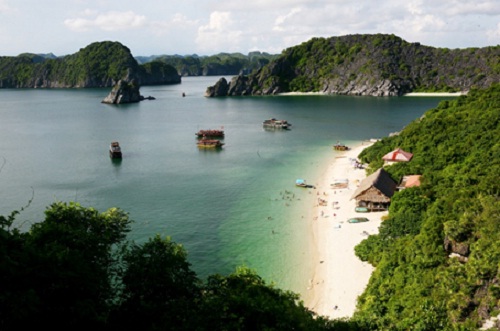
Halong Bay is a spectacular location for sightseeing in Vietnam. Located in the Gulf of Tonkin, it forms an amazing seascape of limestone pillars along with more than 1,600 islands and islets. Travelers coming to Halong Bay will enjoy not only the boat trip, sea kayaking but also the very scuba diving experience. Scuba diving has been recently opened in Halong Bay making this place a must-sea for underwater lovers. The time from April to December is the most wonderful period for Travellers to join “Halong Bay Scuba Diving”. The temperature of water at this time is from 26-29 celsius degrees. Travel Halong bay

Scuba diving with Halong Voyage – a the special product which no one has done before in Halong bay. Travelers can explore hidden beauty underwater with thousands of splendid coral and fish like sergeant major fish, Clark’s anemone fish. Tourists will see colorful their method survive. Underwater world will make you to feel novel, small and peaceful as come back inside your mother. Tourist will perfect relax and excited to discovery underwater world.  With internationally-licensed, well-trained scuba divers and assistants, we guarantee the safety, papering amenities with friendly and attentive management which make you unforgettable experience. Vietnam tours
Scuba-Diving in Halong Bay
When tourists snorkel underwater in Halong bay, you will provide useful equipment such as: mask, fins, snorkel, cylinder, exposure suite, compass, regulator…  All facilities are regularly checked and match safety standard. Therefore, it’s unnecessary to worry about your safety.
Some Tips for diving longer and deeper safely

There are a number of techniques to increase the diver's ability to dive deeper and longer:

- Technical diving – diving deeper than 40 meters (130 ft), using mixed gases, and/or entering overhead environments (caves or wrecks)

- Surface supplied diving – use of umbilical gas supply and diving helmets

- Saturation diving – long-term use of underwater habitats under pressure and a gradual release of pressure over several days in a decompression chamber at the end of a dive.

Thứ Năm, 6 tháng 11, 2014

Tips for safe dining of seafood in Halong

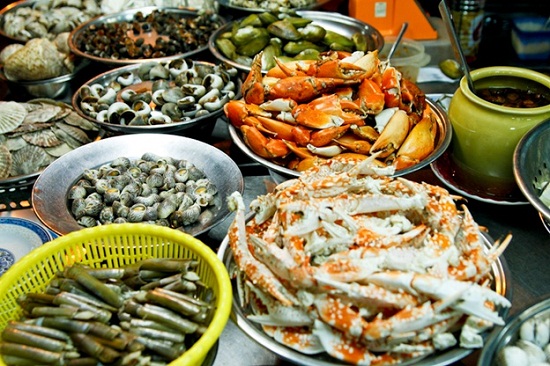
Halong, known as the world heritage city with thousands of caves and grottos, is also famous for its abundance of nutritious and delicious varieties of seafood like crab, prawn, fish, or sea-snail. Gourmets who come to Halong can hardy resist the taste of fresh seafood without the worry of gaining weight. However, there is always risk of food poisoning hidden in seafood. Below are some safety tips to avoid trouble with dining in Halong bay tours.

1. Avoid eating raw seafood in general

Raw seafood or unprocessed seafood may contain the Vibrio parahaemolyticus bacteria which is harmful for the digestive system. Moreover, the bacteria can live under high temperature (more than 80oC). Although sushi and sashimi is very tempting, try not to eat too much, esepecially from the dubious dining places. Fresh seafood in Halong Bay

2. Never eat raw crab
Tips for safe dining of seafood in Halong

Inside unprocessed Ha Long’s crab is a very dangerous parasitic bacteria named lung fluke that may mess up your respiratory system with symptoms like lead to severe cough, coughing up blood, or even cerebral paralysis. It is highly recommended that crabs have to be fully cooked for at least 20-30 minutes. Travel to Halong with Vietnam tours

3. Seafood shopping tips

Buying your own seafood in a market to bring back to your hotel and ask the chefs to cook for you is a very enjoyable experience. However, remember to choose ones which are still alive and fresh, because dead sea-animals, especially one that has shells, contain much higher level of bacteria or poisons.

4. Avoid drinking excessive beer while eating seafood

Scientists say drinking beer while eating seafood increases the probability of having gout or arthritis disease. Therefore, it is recommended that you limit your alcohol consumption when being served seafood.

5. Avoid having fruits/tea after having seafood

The reason is that the acid inside sour fruits may negatively affect the process of absorbing protein from seafood into your body. Besides, tannin from fruits may react with calcium and protein from seafood to stimulate your digestive system that leads to stomach-ache and vomiting. Same thing happens if you drink tea after a seafood meal.

Thứ Năm, 30 tháng 10, 2014

Cách phân biệt nhung hươu thật giả

Hàng quý tộc khó kiểm định

Đặc tính của hươu nai giong là chỉ con đực mới mọc sừng. Khi mới mọc, sừng non (thường gọi lộc nhung) có chiều dài khoảng từ 5-20cm, mềm, mặt ngoài phủ đầy lông tơ màu nâu nhạt, phía trong sừng có nhiều mạch máu. Theo ông Lê Tá, một chủ trang trại từng nuôi hươu nai khai thác lộc tại quận 12 (TPHCM) nay đã giải nghệ, nhung hươu đẹp nhất nặng từ 5-6 lạng (500-600gram). Một đời hươu đực trải qua 16-18 lần cắt nhung, mỗi năm cho nhung một lần.

Ông Tá tâm tình: Khi đi mua nhung huou nguyen chat, vì sợ lầm hàng, người sành điệu chỉ mua lộc khi họ được tận mắt chứng kiến cảnh cưa cắt mà thôi. Nhưng không phải ai cũng có kinh nghiệm, thời gian, tiền bạc, sức khỏe để lặn lội hàng chục, thậm chí hàng trăm kilômet đến các trang trại đặng chứng kiến tận mắt cảnh cắt cưa ấy. Điều này đồng nghĩa với việc nhiều người phải mua lộc nhung qua các mối trung gian. Tận dụng cơ hội đó, dân buôn lộc trời ơi thường gả những cặp lộc quá lứa cho khách với giá hàng xịn.

Theo các chuyên gia, lộc nhung tốt là loại mềm, chưa phân yên, nghĩa là khi dùng dao cắt sẽ thái được toàn bộ chứ không đụng xương tảng, không đứt (dấu hiệu chuyển sang sừng).
Cách phân biệt nhung hươu thật giả


Lương y Đỗ Mạch, ở phố thuốc Hải Thượng Lãn Ông (Q.5, TPHCM) chỉ rõ cách nhận biết giá trị thực tế của lộc nhung hươu, nai. Hươu có lông đen mịn, có đốm, còn nai thì to hơn hươu, lông cứng hơn, có màu xám hoặc nâu. Mùa thu hoạch nhung hươu thường vào tháng 2-3 âm lịch, mùa nhung nai chậm hơn 1-2 tháng sau đó. Nhung nai có màu sẫm, lông nâu, to, nặng và rẻ hơn nhung hươu. Nếu như lộc nhung nai có giá khoảng 5 triệu đồng một kilôgam thì lộc nhung hươu có giá trị hơn, khoảng từ 6-7 triệu đồng. Vấn đề ở chỗ nếu không biết cách nhận biết đâu là nhung hươu, nai thì khách rất dễ bị luộc.

Lương y Mạch tiết lộ xảo thuật làm giả lộc nhung huou tuoi nai của phường gian thương: Bọn gian tạo hình lộc nhung bằng cách nhét tiết lợn cùng xương thỏ băm nhỏ vào da chó, da dê con rồi dùng một loại keo đặc biệt dán chặt. Để chắc ăn, tiếp đó họ sẽ bôi thêm phẩm đỏ hoặc phẩm có màu nâu nhạt đặng xóa vết dán. Thấy cặp nhung đỏ màu tươi rói, nhiều người lao vào mua và… dính đạn.

Lương y Mạch khẳng định: Đây chính là cội nguồn của hiện tượng nhiều con buôn không nuôi hươu nai nhưng nếu khách có nhu cầu bao nhiêu cặp lộc nhung thì họ sẵn sàng đáp ứng trong thời gian ngắn nhất. Do vậy nếu không trực tiếp thấy chủ trang trại cắt lộc thì đừng… xông trận.

Cẩn trọng kẻo mất mạng!

Qua nghiên cứu, cả Đông lẫn Tây y đều đi đến kết luận, lộc nhung có tác dụng giúp người bệnh ngủ ngon, giảm mệt mỏi, tăng sức đề kháng cho cơ thể, giúp vết thương chóng lành và nhất là có tác dụng tốt với các chứng bệnh như tim, nhược năng, bệnh thần kinh thực vật…

Để bán được hàng và bán được với giá cao, nhiều ông bà chủ trang trại hươu nai nhân kết luận đó mạnh miệng tuyên bố thêm, nam-phụ-lão-ấu ai dùng lộc nhung cũng tốt. Người có bệnh thì dùng chữa bệnh, không bệnh thì giúp bồi bổ sức khỏe, ngăn ngừa bệnh tật.

Lại có vị chủ trại cam đoan ai dùng lộc nhung do trang trại mình cung cấp sẽ có nước da láng mịn, mái tóc mượt mà, đàn bà sung mãn, đàn ông thăng hoa. Các chứng bệnh như vô sinh, lao phổ, viêm gan, xơ gan… cũng bị dược tính của lộc nhung đẩy lùi mà dứt tiệt.

Nói đến đây, lương y Mạch lắc đầu: Không chỉ đồn uống rượu ngâm lộc nhung không lo chưa đến chợ đã hết tiền, nhiều ông bà chủ còn tuyên bố chắc nịch uống rượu lộc nhung có sức bắn phá lung tung, bắn chỗ nào là dính con trai chỗ nấy. Một đồn mười, mười đồn trăm, vậy là hình thành trào lưu… nguy hại.

Như lương y Mạch, lương y Hoàng Linh ở nhà thuốc Vạn Xuân cho rằng, lộc nhung có vị ngọt, mặn, có công năng bổ tủy, trợ thận âm…, biết dùng rất tốt cho sức khỏe nhưng nếu lạm dụng sẽ phản tác dụng bởi không phải ai dùng cũng tốt, càng không phải là thuốc tiên chữa bách bệnh.

Lương y Linh cảnh báo: Nhung hươu là chất bổ âm, chỉ dùng tốt với người thận dương không đủ. Những người bị cao huyết áp, có hội chứng âm hư với biểu hiện người gầy, hay có cảm giác sốt về chiều, môi khô, miệng khát, đại tiện táo, tiểu tiện sẻn đỏ… tuyệt đối không được dùng lộc nhung. Người còn trẻ hoặc có sức khỏe bình thường khi dùng lộc nhung phải tiến hành theo dõi tình trạng sức khỏe. Nói chung mọi người không được tùy tiện dùng lộc nhung khi chưa có chỉ định hoặc tham khảo ý kiến của các lương y, bác sĩ. Đã có nhiều trường hợp tự ý sử dụng lộc nhung và sử dụng vô tội vạ dẫn đến hậu quả thương tâm: Toàn thân bị co giật, động huyết, ngực phát nóng, liên tục đổ mồ hôi trộm… để rồi khỏe đâu không thấy, chỉ thấy bệnh tình càng nặng thêm.